The co-parenting schedule you both have at hand
Set up who has the kids when in just a few minutes. Swap a day, export to your calendar, track your care days.
Aug 9 — birthday, stays with Mom this year
The agreement is clear. The follow-through isn’t.
Almost every parenting plan starts with a schedule you both agreed on. What happens after that isn’t written down anywhere.
The Wednesday that shifts because of a school training day. The party that falls on the other parent’s weekend. The holiday week one of you thought started on Friday and the other thought started on Saturday. On their own they’re small things. Together they’re dozens of messages a month, and every message is a chance for disagreement.
It rarely goes wrong because someone breaks the agreement. It goes wrong because you’re each looking at a different version of the same agreement — one of you carrying it in your head, the other in a group chat from three weeks ago.
One schedule, that you both see
CoParIzi puts your agreement in one place you can both reach. Who has the kids when, what you agreed for holidays and public holidays, and which swaps have been requested — all in the same overview.
When something changes, it changes for both of you at once. Nobody has to pass anything along, and nobody has to dig up what was agreed in the first place.
It also helps when contact between you is strained: a swap request in the schedule is a request with a date and a reason attached, not a message that can land the wrong way.
From scattered texts to one clear schedule
Six steps, about fifteen minutes. After that you’re both looking at the same schedule — and it’s in your own calendar.
Add the children
Pick a colour per parent and set what the kids call you, so you can see whose days are whose at a glance.
Invite the other parent
The other parent gets an equal account. There’s no main account, and neither of you can overrule the other.
Set up the schedule
Choose the type of schedule and the start date, and set a handover time per swap — because "on Friday" leaves room for two readings.
Sort out special dates
Import your region’s public holidays and school holidays, or add your own dates that just apply to you.
Choose your subscription
One subscription for the whole family, with 21 days free and no obligations.
Approve the schedule
You both confirm the schedule. Then add the iCal link to your own calendar, which keeps itself up to date from then on.
Try it first, no account needed
Five tools to help you sort out your care schedule — build a schedule, compare arrangements, split the holidays and more. All free.
Schedule generator
Pick a pattern, set your handover day, and see your whole year at a glance — including school holidays and public holidays.
Schedule comparer
Five questions about your child’s age, the distance between your homes, and your work schedules. Then see which patterns fit and which don’t.
Holiday splitter
Split the school holidays with the official dates for your region already built in. Alternate years, split in half, or divide into blocks.
Care days counter
Count how many days and nights per year each parent ends up with, including holidays and public holidays. Often different from what you agreed on paper.
Parenting plan helper
Work step by step through everything a parenting plan needs to cover, so you don’t miss anything and arrive at the mediator with a complete document.
Which schedule fits you?
There’s no schedule that works for every family. What decides it: your child’s age, the distance between your homes, and your work schedules. These are the four arrangements used most in the Netherlands.
Week on/week off
one handover a week, plenty of calm and little back-and-forth packing. Works for most children from around age eight.
2-2-3
never more than three days away from either of you. Popular with younger children, but three handovers a week means you need to live close together.
3-4-4-3
fixed weekdays, two handovers a week, the weekend stays with the same parent. The compromise between calm and frequency.
Every other weekend
one parent has day-to-day care, the other has every other weekend and part of the holidays. Practical when an equal split isn’t workable.
Not sure? Every schedule is worked out with a calendar, the situations it works for, and the downsides that come with it.
What fits changes as your child gets older
A schedule that worked well three years ago probably doesn’t fit anymore. A baby needs short, regular contact moments. A ten-year-old wants their things in one place. A teenager mostly wants a say in their own week.
Everything for co-parenting, in one place
From the schedule to the costs. These are the six that matter most to parents in practice.
A schedule that calculates itself
week-on/week-off, alternating weeks, or a custom cycle. Set it up once, and the calendar stays correct from then on.
School holidays and public holidays, automatically
your region’s official holiday dates in one click, plus birthdays and holidays that alternate year to year.
Swap requests with counter-proposals
request a swap and the other parent accepts, declines, or proposes a different date. What was agreed stays there to look up.
Joint approval
a new schedule only takes effect once you’ve both confirmed it. Nothing happens unilaterally.
A calendar that keeps itself up to date
add the iCal link once to Google Calendar, Apple Calendar or Outlook. If the schedule changes, your calendar follows.
Shared costs
record an expense once and see per period who owes whom. Photographing a receipt is enough.
Also included: in-app messaging, shared appointments, a handover checklist, travel consent letters, a full activity log, and your own calendar link for your child, a babysitter or a grandparent.
Your data, and no one else’s
Both parents have their own login and an equal account. There’s no main account: whoever takes out the subscription can’t overrule or lock the other out. You share the schedule and the agreements that go with it — not each other’s account, not each other’s messages, not each other’s location.
We don’t sell data and we don’t show ads. Your data is processed within the EU, in line with the GDPR. Want to stop? You can export your data and delete your account.
One subscription per family
Both parents share the same subscription. You don’t pay twice for one schedule, and you don’t need to work out who takes it out — one of you sets it up, the other just joins in with an equal account.
There are three plans. Essential is the schedule and calendar. Together adds coordination between you: messaging, swap requests and shared appointments. Everything adds shared costs on top of that.
Every plan starts with 21 days free — the full plan, not a stripped-down trial. That’s deliberately longer than a typical trial: with week-on/week-off, a full cycle takes two weeks, and you only really find out if something works once you’ve been through that cycle in full, including the handover that shifts and the weekend that runs differently.
Still have questions?
Does the other parent have to join too?
For the full overview, yes — the whole point is that you’re both looking at the same schedule. You can set the schedule up on your own first and invite the other parent afterwards.
What if we don’t agree on the schedule?
CoParIzi doesn’t decide anything for you. It records what you agree and makes changes visible. If you can’t work it out between you, a mediator is the next step — you can just bring the schedule from the app along.
Do we both pay?
No. One subscription covers the whole family. It makes no difference to the features who takes it out: both parents get an equal account, and there’s no main account.
Can the other parent see what I’m doing?
No. You share the schedule and the agreements that go with it. Beyond that, each parent has their own account and their own data.
Does it work with our own schedule?
Yes. Alongside week-on/week-off, 2-2-3, 3-4-4-3 and every other weekend, you can put together your own split, including one-off exceptions.
Can I put the schedule in my own calendar?
Yes, via an iCal link. You add it once to Google Calendar, Apple Calendar or Outlook, and after that your calendar stays automatically up to date whenever the schedule changes.
Working as a mediator or separation professional?
A schedule clients keep using after the process ends means fewer repeat questions about agreements nobody can find anymore.
→ Read more for mediatorsAbout care division after a separation
Care division ("zorgverdeling") is the agreement about who has the kids when, and who takes on which caregiving tasks. For parents who both hold parental authority, Dutch law calls this a "zorgregeling"; where only one parent holds authority, the law calls it an "omgangsregeling". Co-parenting isn’t a legal term — it’s the everyday name for a split where care is roughly equal.
Dutch law doesn’t prescribe a schedule. You decide for yourselves how care is divided, as long as the split serves the child’s interests and you record it in a parenting plan. In practice, three things decide what’s workable: your child’s age, the distance between your homes, and your work schedules.
The schedule itself is rarely where things go wrong. The follow-through is — the handover that shifts, the holiday that starts differently than expected, the school training day nobody saw coming. That’s why it’s worth recording, alongside the schedule, what time and where you hand over, who does pickup and drop-off, what happens if a child is ill, and how much notice a swap request needs.
Finally, expect the split to stop fitting at some point. A child moves to secondary school, one of you relocates or changes jobs. That’s not a failure of the agreement — it’s the normal course of things. So build a check-in moment into the plan from the start — then neither of you has to be the one to start a conversation that can come across as a complaint.
→ More about care divisionTips for co-parenting and sharing a schedule
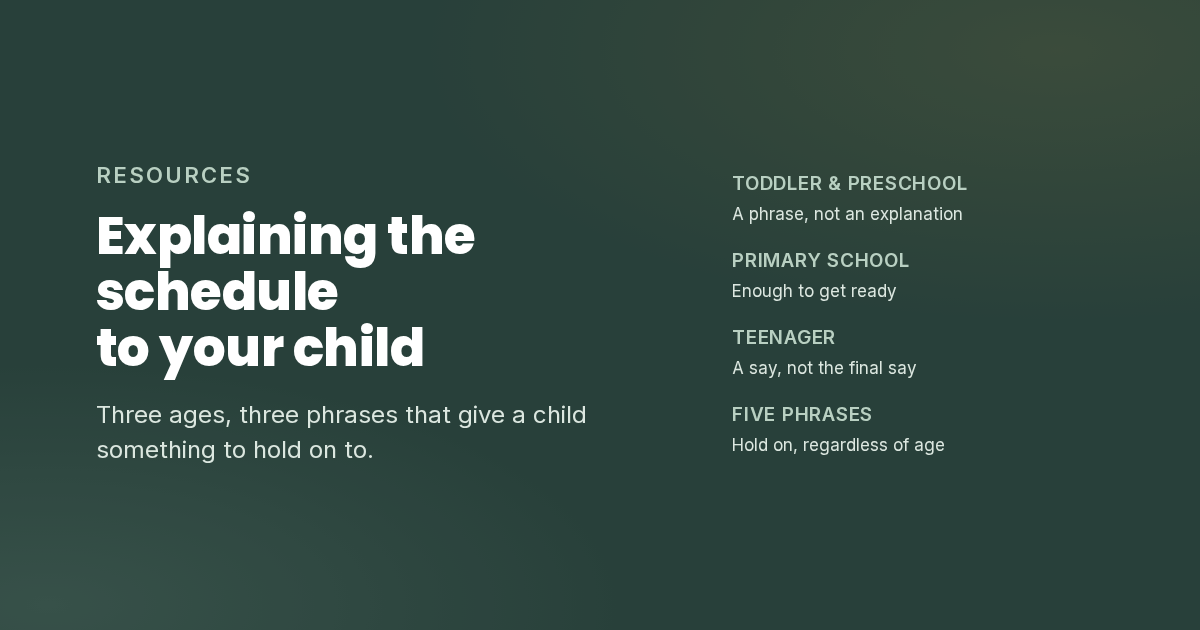
How to explain the schedule to your child, by age
A toddler doesn't need a reason, just a short sentence. A teenager doesn't want to decide, just to be heard. Three age brackets, and a phrase for each that gives a child something to hold on to instead of too much at once.

Fighting over the app: how to stop the message becoming the argument
An accusation invites a defence; a fact doesn't. Four examples of how the same message lands very differently — and when a phone call beats a text.
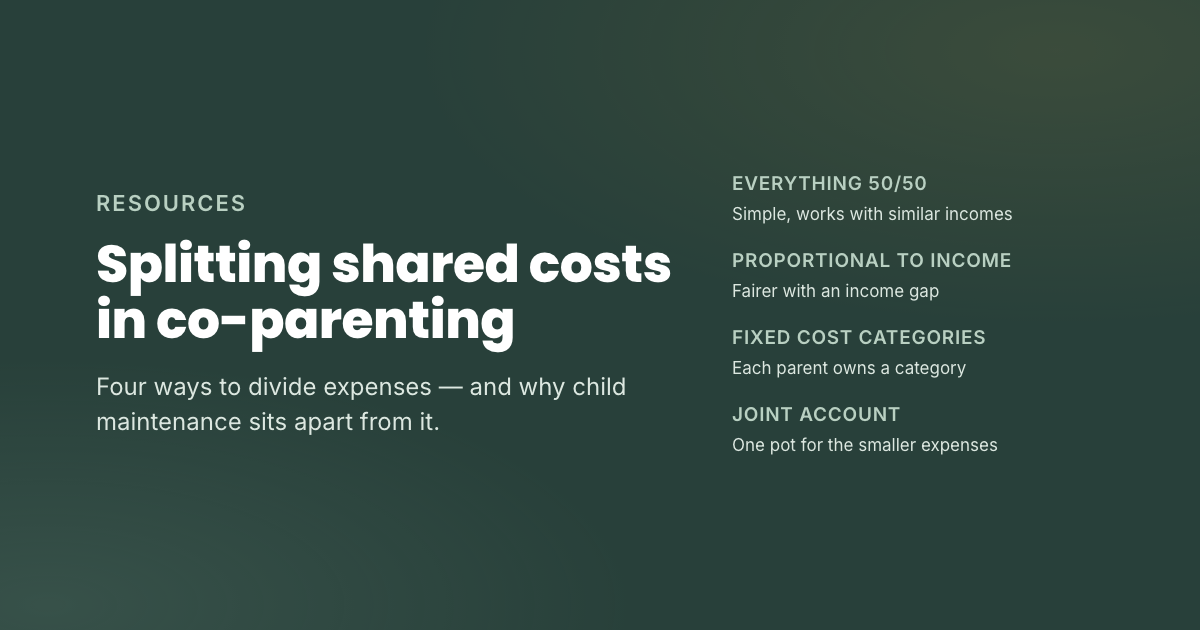
Splitting costs in co-parenting: four ways
Child maintenance doesn't cover everything: a school trip, new trainers, a birthday present. Four ways to split those shared costs fairly.
Start today with a clear co-parenting schedule
Invite the other parent and set up your schedule in a few minutes. Free for 21 days.